D7.4 Material in learning content management system
TODO:
- Trim list of lectures, either because:-
- Lectures are simply outlines of possible content
- Not relevant to MareFrame
- List of (my) work is edited for content-relevant details, not things like the chat server and smileycoin work. should we add everything?
Executive summary
In this document we introduce tutor-web, the Learning Content Management System (LCMS) chosen to store MareFrame learning material, then outline the available content. Finally we show some examples of the output available in tutor-web.
Tutor-web introduction
The learning material for MareFrame has been incorporated into an existing LCMS, tutor-web. Tutor-web is both a learning tool for students and a research platform into e-learning. Tutor-web has been used for approximately 4000 students, at the University of Iceland as well as further afield; it's capabilities for working off-line have proven invaluable for teaching in Kenya, where internet connections are not readily available.
Tutor-web provides facilities for producing lecture slides, handout material for students to study, and a drill environment for students to study interactively by answering questions.
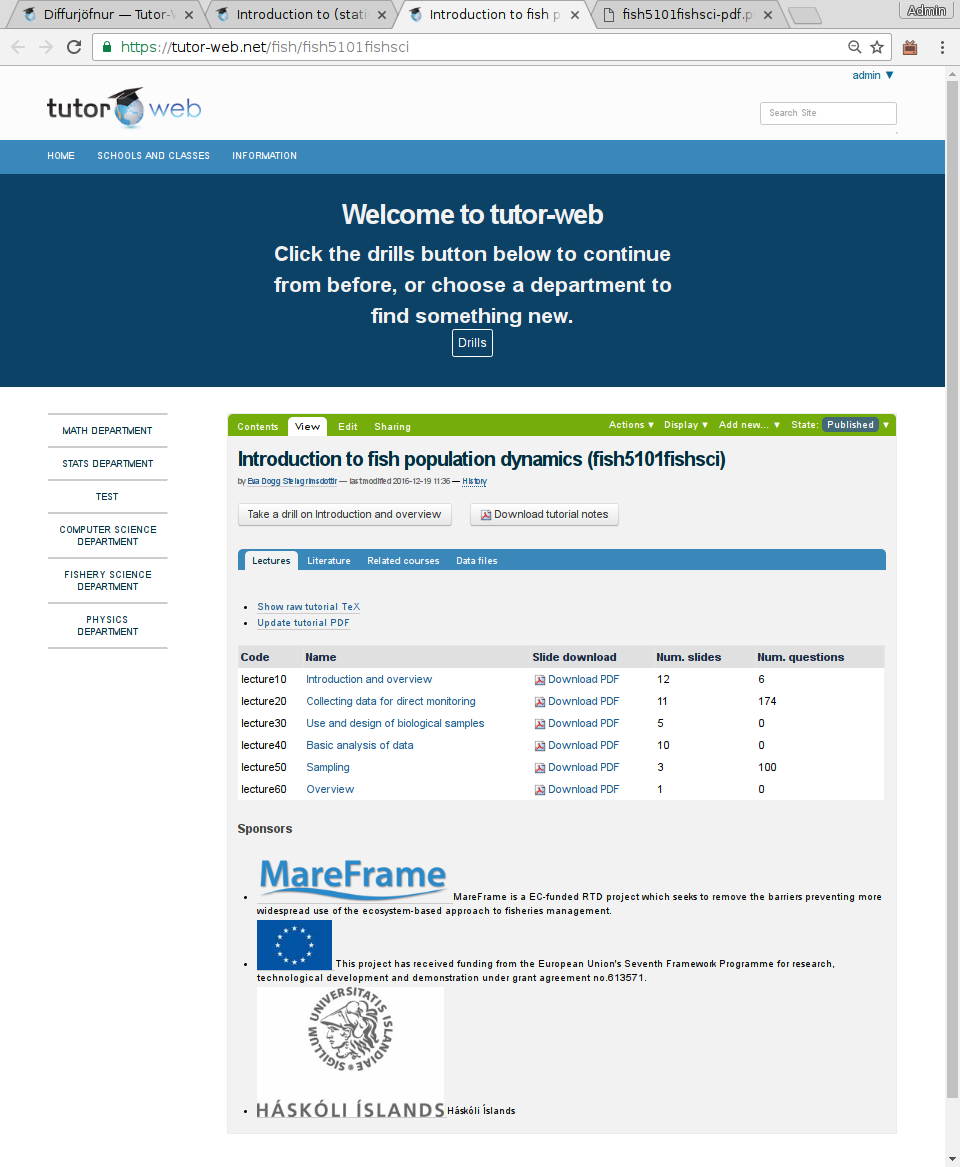
Tutor-web interface
The drill environment adapts to the students capabilities, ensuring the student has questions to match their skill level to enhance learning. Many aspects of the system are parameterised, and can be assigned random values for each student, allowing experiments to be performed.
The drill environment, whilst working within a browser, is designed to continue working even without an internet connection, so a student can keep going when connection to the server isn't possible, for example if the wireless network in the auditorium is struggling, a student is trying to work on a train, or a student isn't allowed permanent internet access---there are tutor-web students currently in prisons, for example. In the extreme case, the Kenyan installations allow students to take a tablet home and continue working until their next visit to the classroom, which could be as much as a month away, at which point their work can be uploaded.
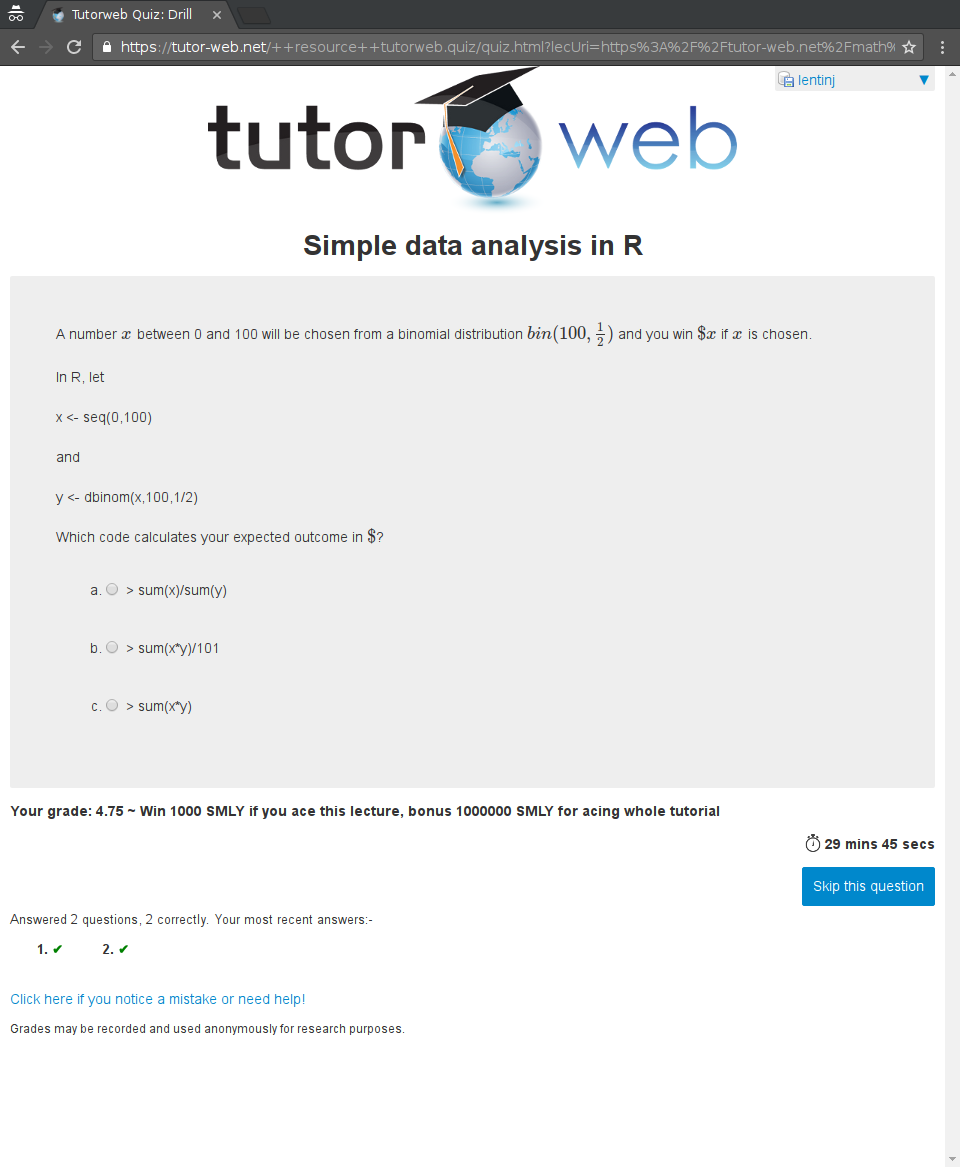
Tutor-web drill interface
Tutor-web is also integrated with the cryptocurrency Smileycoin (SMLY), giving awards for students when they do well. This then allows us to form a wider economy of places where these can be spent. To date a game has been developed with in-app-purchases in SMLY, a chat system where students can pay others in SMLY for help with lecture questions, paying for coffee from the student canteen, and buying vouchers for various places.
All Tutor-web content is organised into courses, tutorials and lectures. Students can either be part of a class where lectures are assigned to them or they can choose any tutorial for self-directed learning.
Content developed as part of MareFrame
As opposed to developing a dedicated "MareFrame tutorial", the content has been organised together with the output of other projects. This makes more sense for any future students and increases dissemination potential for MareFrame---for example the Discard material developed as part of the MINOUW project is integrated with MareFrame EAFM content. So students will learn about the outputs of both projects in the process.
The content developed as part of MareFrame is spread over 3 courses, an outline of the content of each is below.
math612 - Computing and calculus for applied statistics
This course can be found at https://tutor-web.net/math/612 and covers the following topics:
- Numbers, arithmetic and algebra
- Numbers, arithmetic and basic algebra
- Data vectors
- More on algebra
- Discrete random variables and the binomial distribution
- Functions
- Polynomials
- Simple data analysis in R
- Indices and the apply commands in R
- Functions of functions and the exponential function
- Inverse functions and the logarithm
- Elements of calculus
- Continuity and limits
- Sequences and series
- Slopes of lines and curves
- Derivatives
- Applications of differentiation
- Integrals and probability density functions
- Principles of programming
- The Central Limit Theorem and related topics
- Miscellanea
- Some notes on statistics and probability
- Multivariate probability distributions
- Some distributions related to the normal
- Estimation, estimates and estimators
- Test of hypothesis, P values and related concepts
- Power and sample sizes
- Linear algebra, multivariate calculus and multivariate statistics
- Vectors and Matrix Operations
- Some notes on matrices and linear operators
- Ranks and determinants
- Multivariate calculus
- The multivariate normal distribution and related topics
- Topics in statistics and probability
- Independence, expectations and the moment generating function
- The gamma distribution
- Notes and examples: The linear model
- Some regression topics
fish510 - Introduction to (statistical) fish population dynamics
This course can be found at https://tutor-web.net/fish/fish510 and covers the following topics:
- Introduction to fish population dynamics
- Introduction and overview
- Collecting data for direct monitoring
- Use and design of biological samples
- Basic analysis of data
- Sampling
- Overview
- The development of a year-class
- The development of a year-class
- Catch curve analysis.
- Natural mortality
- Stock and catch equations
- Modelling length at age and length distributions
- Lack of age data - background
- Growth models
- Models of length distributions
- Case studies in analysis of length data
- Length-weight relationships
- Modelling the development of a length distribution
- Using length data in population models
- Using length data in population models
- Assessment methods based on back-calculations
- Simple back-calculation techniques
- Virtual Population Analysis (VPA)
- Cohort analysis
- Yield per recruit analysis
- Introduction
- Yield per recruit analysis
- Spawning stock biomass per recruit
- Yield per recruit case studies
- Effect of assumptions on yield per recruit analysis
- Spawning stock, recruitment and production
- Spawning stock and recruitment
- Estimation methods
- Production and replacement
- Yield potential
- Harvest control rules
- Stock-recruitment functions in relation to ecological theory
- More general analyses of interactions
- Prediction of stock and catch
- Introduction
- The issue of harvest control laws
- Short-term prediction
- Medium-term predictions
- Linking assessments and all projections
- Case study
- Statistical stock assessment methods
- Statistical techniques for stock assessments
- Production models
- Fitting criteria
- Formal statistical stock assessments in dynamic bulk production model
- Case studies of stock-production models
- Models with internal age structure
- Finicky details
- Some case studies
- Principles of utilization: The precautionary approach
- Principles of utilization
- Reference points
- Harvest control rules
- Case studies
fish610 - Ecosystem Approach to Fisheries Management
This course can be found at https://tutor-web.net/fish/fish610 and covers the following topics:
- Introduction to the Ecosystem Approach to Fisheries Management
- Introduction to Fisheries Management
- Introduction to EAFM
- Principles of EAFM
- Benefits of EAFM
- Further Reading
- Ecological Considerations of EAFM
- Individual Considerations
- Habitat Considerations
- Community Considerations
- Climatic Considerations
- Societal Considerations of EAFM
- Fleet Considerations
- Regulatory Considerations
- Trade-offs
- Ecological Trade-offs
- Economical Trade-offs
- Societal Trade-offs
- Further Reading
- Applying the EAFM
- Developing an EAFM Management Plan
- Writing an EAFM Management Plan
- Implementing an EAFM Management Plan
- Applying Adaptive Management to an EAFM Management Plan
- Further Reading
Samples of this content can be found in the appendix, for full content, you can visit https://tutor-web.net and download content.
Features developed as part of MareFrame
Tutor-web has also been expanded as part of MareFrame to provide extra features to support the extra content. Some examples of new features include:-
- HTML view of lecture content integrated into the drill interface
- Handout PDF output fully managed by tutor-web
- Slide output for presentation in lectures, both in HTML view and PDF downloads.
- Colour output of examples
- Generating graphic output for both handouts and slides from R code.
- Improvement of code listing outputs
Conclusion
There is now a reasonable breadth of EAFM and related content freely available in Tutor-web. Further depth will be added to the content in the future as part of other projects, building on the legacy of MareFrame.
Appendix: Samples of extra content
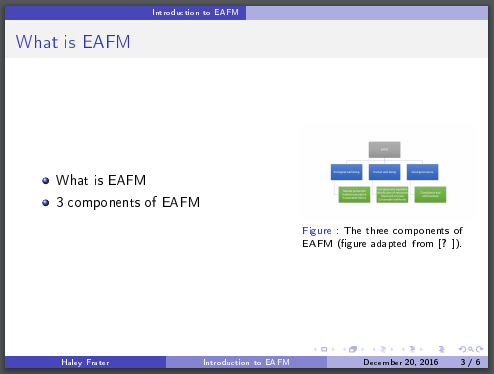
Example of slides generated in Tutor-web, this is the introduction to the EAFM course
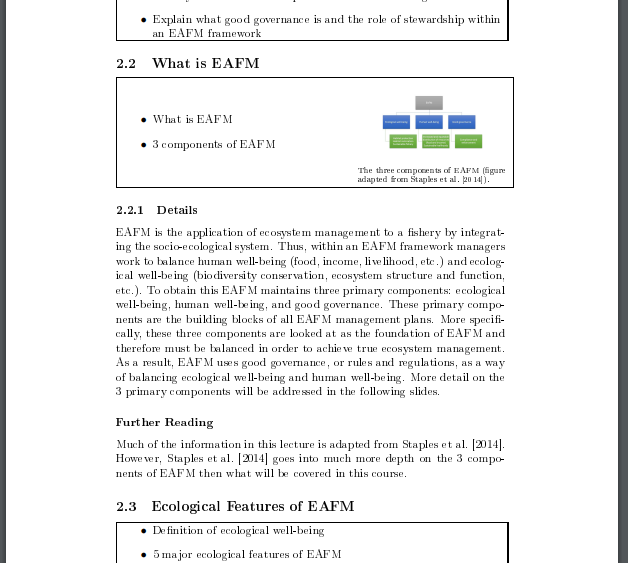
The same section as above, but in handout form. Note the additional material which otherwise would be lecture notes.
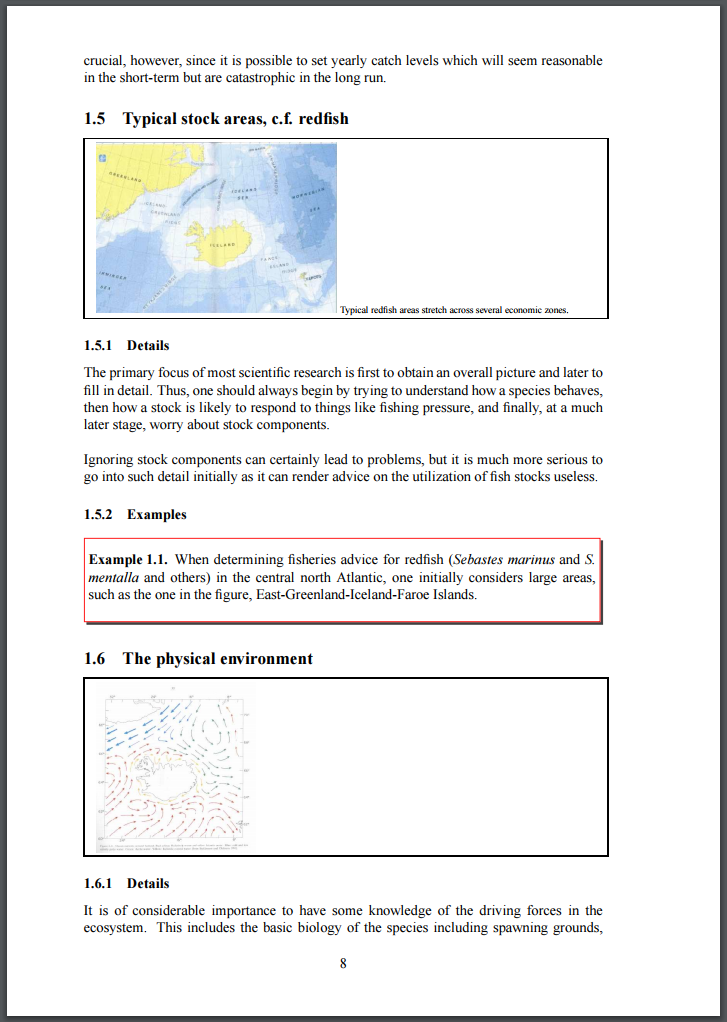
Example from the fish population dynamics course, showing available techniques
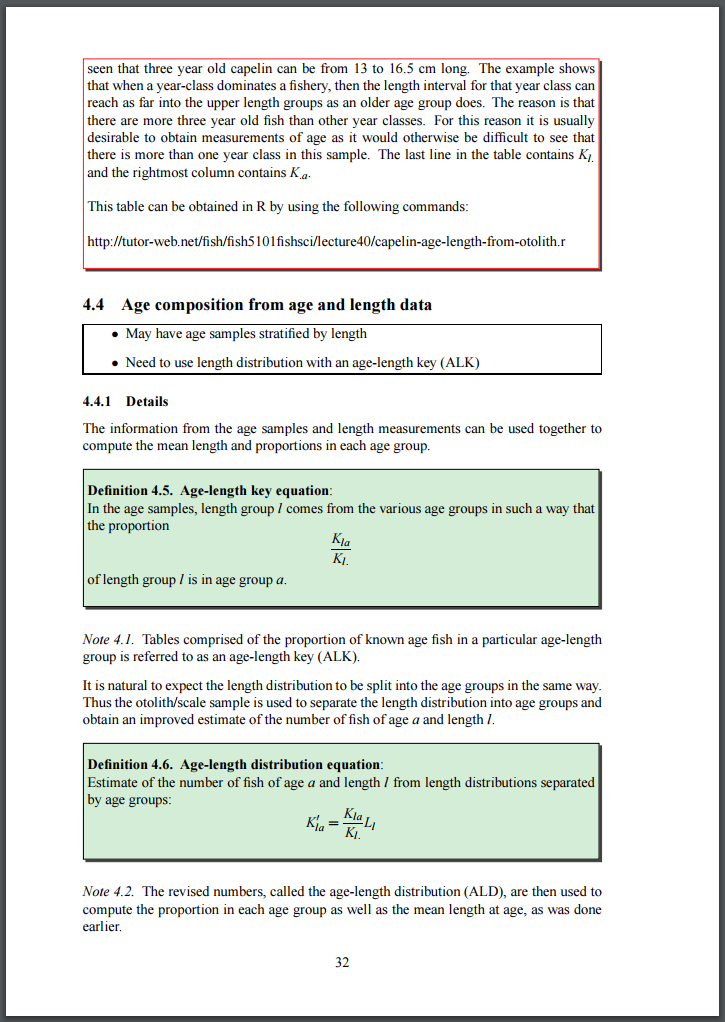
Example from the fish population dynamics course, showing definitions and formulae